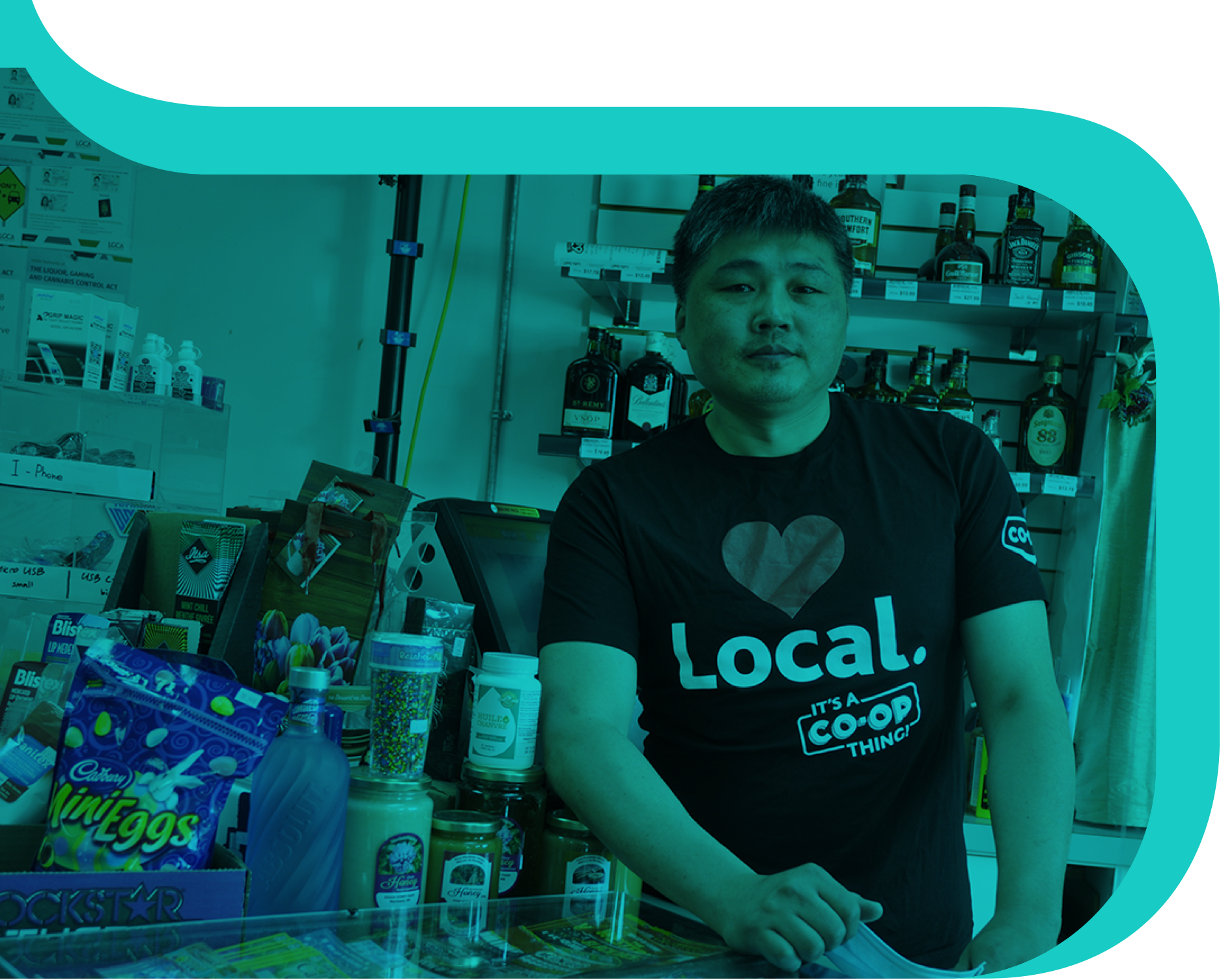
Originally from Seoul, South Korea, Woojin Park immigrated to Winnipeg, Manitoba in 2009. In 2013, he finally bought a business in Saint Agathe, the Cheyenne Convenience Store, and established himself professionally. A successful transition thanks to the support and kindness of the local population.
When Woojin Park immigrated to Manitoba in 2009 under an economic program, one of his conditions of immigration was that he open a business. Four years later, in Saint Agathe, the opportunity presented itself: with his wife, who joined him in Manitoba with their two children in 2010-2011, Woojin Park bought the Cheyenne Coop Convenience Store.
“I felt very welcome in Saint Agathe,” says the businessman. “The people here are very nice. They helped me by giving me a lot of information. There is a real sense of community and togetherness here.”
He remembers his first days at the Coop. “When I took over the convenience store, everyone in the village came by to say hello! It was very busy!”
He is particularly touched by their patience with his accent. “My English is not very good, but the people of Saint Agathe always try to understand me. And they speak slowly so I can understand them better. They are very patient with me. When I was in Winnipeg, people didn’t want to take the time to try to understand me.”
Woojin Park has also benefited from the support of other businesspeople in the town. “There are a lot of businesses in Saint Agathe that I can count on, including the garage next door. I know that if I have a problem or a question, I can go to them and they will help me. It’s reassuring.
“I’ve noticed that people in small towns, like Saint Agathe, are generally much more direct and patient than those in big cities. There are many advantages to being in the countryside. We’re like one big family.”
Today, his two children are adults, and they sometimes come to help him at the convenience store. “We’re kind of a family business,” says Woojin Park.
He adds that the Cheyenne Coop Convenience Store also normally employs seasonal workers, including high school students. “We help each other,” he explains. “They help me with my English, and I teach them the reality of the job. Unfortunately, because of the pandemic, we had to stop this year.”
And while the family still resides in Winnipeg, they enjoy taking part in the community life of Saint Agathe, especially in the summer during the Cheyenne Summer Festival. “We have a lot of fun participating,” says Park. “We play baseball with other families. In the evening, there are fireworks and music, and we dance, eat and drink beer. There are always lots of people, and everyone talks to each other. It’s very festive and family-oriented.”
For Woojin Park, life in the country is beautiful and dynamic. “I’m really never bored,” he says. “I alternate between Winnipeg and Saint Agathe. It’s a really good quality of life for me.”
Immigration, an Asset Above All Else
Chris Ewen has been the Mayor of the Rural Municipality of Ritchot since 2017. Not only does he welcome newcomers, he actively encourages them to come.
He explains, “The Rural Municipality of Ritchot often welcomes newcomers. We encourage immigration to our area by having an open-door policy with the government. Canada offers the opportunity to place new Canadian citizens or permanent residents in the province.
“Our weakness is that we are currently limited in terms of work opportunities related to industries and businesses. But we are doing our best to offer everyone the opportunity to settle in our municipality, and we encourage the development of our community.
“Immigration is truly an asset for the strengthening of cultural diversity and the real possibility of sustainable growth in our municipality. It creates a need for local employment in all areas, and if the demand is there, it creates opportunities for residential and industrial construction. On average, we have 10% new residential construction per year.”
“If we have managed to adapt, it is partly thanks to the help of my colleagues and the school principal. Today, we are still adapting, but we feel at