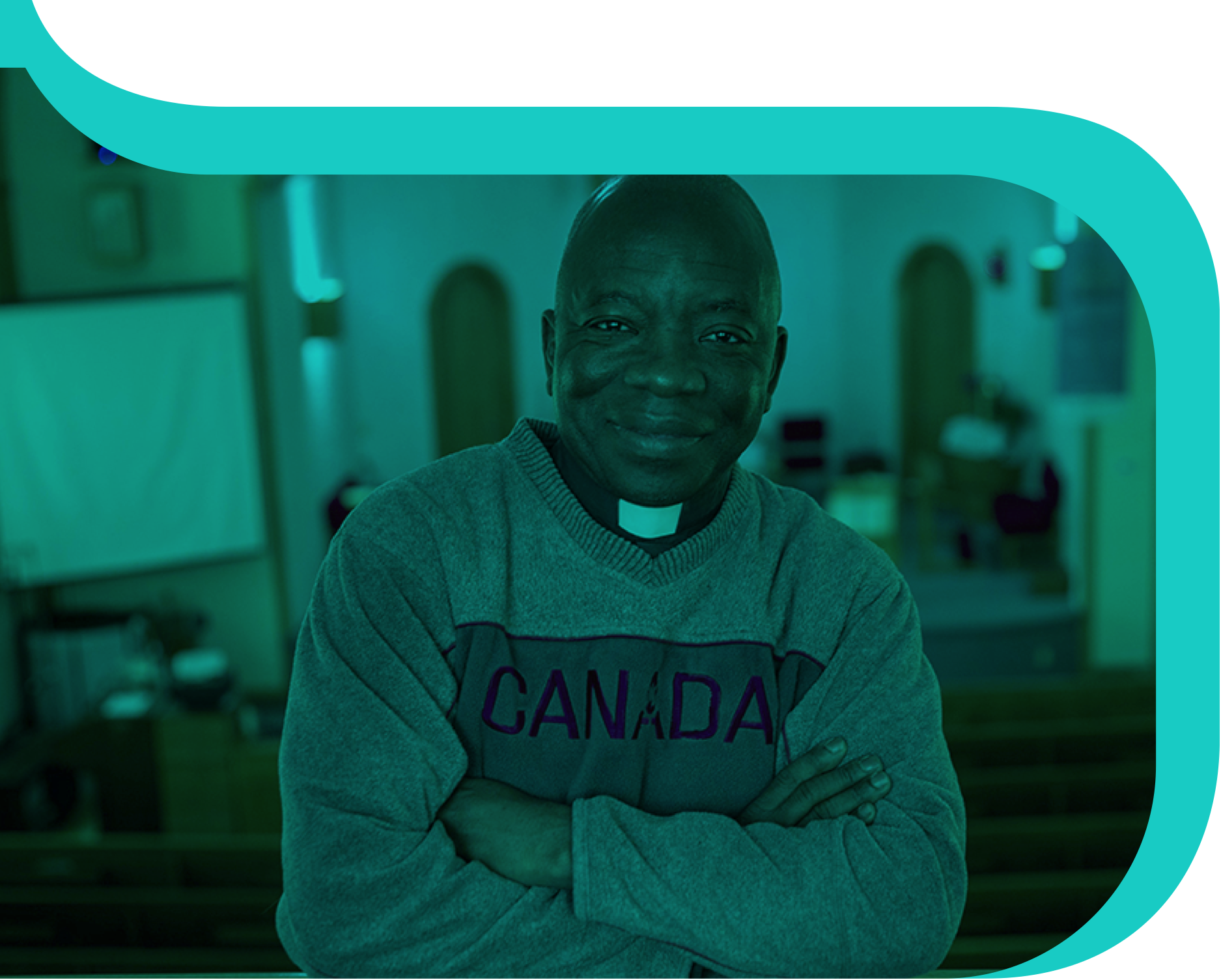
Preaching today in rural Manitoba, Fathers Léon Mubikayi Kalengayi
and Gregory Kossi Djiba are both originally from French-speaking Africa. Without immigration and the possibility of bringing in priests from abroad,
many parishes in rural Manitoba might have closed temporarily or permanently.
Today a priest in La Broquerie, Father Léon Mubikayi Kalengayi received a very warm welcome from the parishioners. And with good reason: for five years before his arrival, the village had no priest.
“It was a priest from another parish who came every week just to say mass and then left. The rest of the time, a lay moderator took care of the administrative activities of the parish.
“Today I can say Mass there every day! It’s really important for the parishioners to have that.”
Originally from the Democratic Republic of Congo (DRC), where he was ordained a priest in 1983, Léon Mubikayi Kalengayi arrived in Manitoba in 2007. “I had heard the prayer of Archbishop Goulet, then Archbishop of Saint Boniface, for more priests and seminarians. Since I spoke French, I decided to answer it.”
He was first sent to Notre-Dame-de-Lourdes, where he stayed for six years, and then to La Broquerie. He has only good memories of his welcome in rural communities everywhere he went: “I came with a service agreement, but I stayed for the love and warmth of the people there!”
Indeed, according to his original service agreement, he was sent to Manitoba by his bishop for six years. Instead, in 2021, he will begin his 15th year.
A Very Warm Welcome
Father Gregory Kossi Djiba, a native of Togo, was given an equally warm welcome when he arrived at the parish of Saint Adolphe on October 1, 2018. “When I arrived, people were very interested in me. They asked me questions about my country of origin, my family, the climate in my country. The welcome was really warm. I felt at home right away.”
A nice welcome that was not limited to parishioners. “In the rest of the town too, when I meet someone who doesn’t go to mass, it always goes very well. People are very nice to me.”
Father Kossi Djiba points out that there was already a bilingual priest in Saint Adolphe before him. “I have only continued his work, adding some personal touches that seem to please the parishioners, such as times of adoration of the Holy Sacraments, devotion to the Sacred Heart of Jesus and confession. A lot of people take part in them.”
Father Gregory Kossi Djiba is also responsible for the Notre-Dame de la Miséricorde parish in Île-des-Chênes, although he does not live there. “I alternate with Father Gérald Michaud, who was already helping the former priest of Saint Adolphe.”
Today, with the pandemic, meetings take place online or by phone, and masses are pre-recorded or livestreamed on YouTube and Facebook. But the parishioners’ bond with their parish priest and the mutual aid remains strong.
Immigration at the Heart of Parish Vitality
For Monsignor Albert LeGatt, Archbishop of Saint-Boniface: “The need to have priests from abroad in our diocese is absolute. Half of the active clergy in our parishes today come from outside. Without them, it would be difficult to have our parishes open for the Eucharist.
“But this is not recent: all the dioceses of Western Canada, both Anglophone and Francophone, have never had enough priests from their own province to meet the demand. From its beginnings, the Diocese of Saint Boniface was already dependent on priests and seminarians from Quebec.”
He also notes that immigration has made it possible to “repopulate the churches, especially in the city. In the Cathedral parish, for example, a third of the Sunday mass faithful are of African descent. These families are the next generation of parishioners. They have given them a new vitality.”
Moreover, every July 1st since 2015, Bishop LeGatt has been saying a multicultural Mass with prayer intentions in 26 languages to celebrate the diversity of the diocese.
“The people in Manitoba are extremely nice and the relationships are simple. Everywhere,
we are well received. We feel like we’re in a land of mutual support. We stick together.”