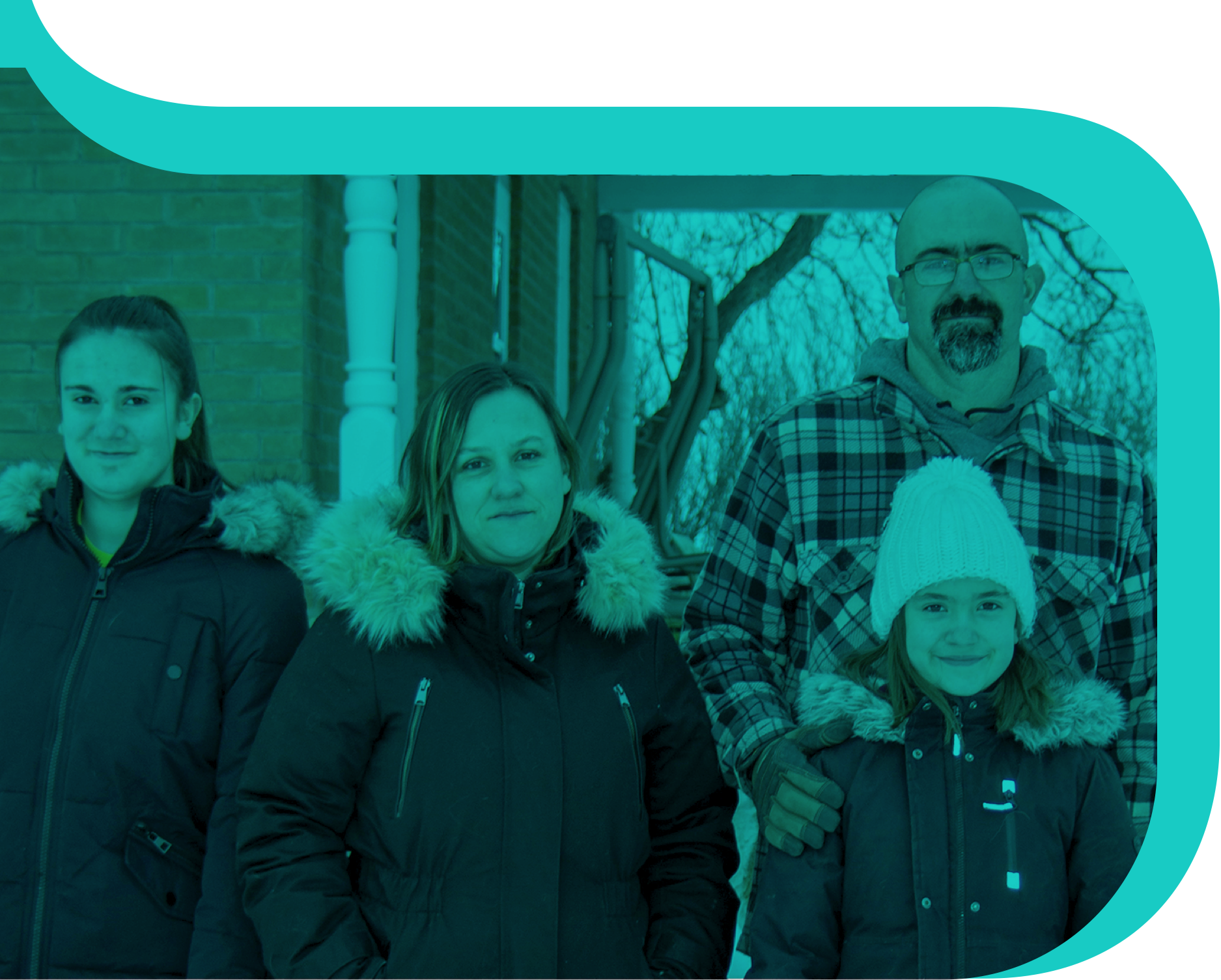
Farmers in France, Caroline and Frédéric Guichard, and their daughters Emma and Faustine, decided to leave their homeland and move to the Brandon area in 2019. What gave them this desire for a new life? The human warmth of rural Manitoba.
It was in 2014 that Frédéric and Caroline Guichard discovered Manitoba while on a 15-day exploratory visit to begin their immigration process. “We felt very welcome. We were able to talk to other families who had gone through what we were going through, it was reassuring. Among others, we were introduced to the Vauzelle family, who have a cattle farm near Brandon, and we really liked this region.”
It was the potential of organic farming and respect for the land that attracted them to Manitoba. Before becoming Manitobans by adoption, the Guichard family lived in the south of France, near Aix-en-Provence, where they had an organic farm specializing in field vegetable production since 2004.
Frédéric Guichard says: “We were well established in France, but the administrative and fiscal constraints imposed on businesses in France were difficult, and the farm plots were increasingly small and shared. We were also worried about urbanization because we were always attracted by the calm and nature.”
Then one day, a neighbour and friend from New Brunswick told him about going to work in Canada. After a lot of research, Caroline and Frédéric fell in love with Manitoba. “What we liked about it was that we sent emails and got immediate feedback from the Association of Manitoba Bilingual Municipalities (AMBM), the Conseil de développement économique des municipalités bilingues du Manitoba (CDEM) and the World Trade Centre (WTC) Winnipeg.”
Rural Manitoba: A Land of Mutual Support
It was finally in January 2019, a few months after selling the farm that the family moved to Manitoba. “When we arrived, we immediately looked for farms for sale in the Brandon area, where we had kept in touch with the Vauzelles,” recalls Frédéric Guichard. “We liked the size of the city, the landscape, the affordability of the land and the presence of a French-language school.
“There weren’t many of them, but finally an opportunity presented itself: a breeding farm whose owner wanted to move to the West. We visited it and we liked it. We took possession of it on July 1, 2019.”
The Guichard family’s plot of land is now 264 hectares, of which about 180 hectares can be cultivated. Frédéric grows organic cereals.
In addition to the Vauzelles and other Francophones in Manitoba who welcomed them into their homes and circles, Frédéric and Caroline Guichard have always been able to count on the support of the CDEM, the AMBM and the WTC Winnipeg, as well as the Division scolaire franco-manitobaine (DSFM).
“At the DSFM, we have always felt very supported. The school has been very careful to ensure that our daughters are well integrated. It is truly an inclusive school. We also have very good relations with our neighbours, who help us a lot.”
As for Caroline Guichard, who had been a librarian and then head of a media library in France for 16 years, she quickly landed a job as a librarian and French language assistant at her daughters’ school in Shilo.
Two years after their arrival in rural Manitoba, Frédéric, Caroline, Emma and Faustine have no regrets about their decision. “The people in Manitoba are extremely nice and the relationships are simple. Everywhere, we are well received. We feel like we’re in a land of mutual support. We stick together.”
An Economic Need
Louis Allain, Executive Director of the Conseil de développement économique des municipalités bilingues du Manitoba (CDEM), is convinced of the benefits of immigration for rural Manitoba communities.
“It’s obvious,” he says. “In terms of professional recruitment in multiple fields, there is a real need for human capital in all of our rural municipalities. Immigration can help with that.”
This is why, for the past two or three years, the CDEM has been taking part in the Welcoming Communities project, “to reverse the trend that newcomers only go to the big cities. We show them that there are business opportunities outside the perimeter, and communities full of vitality with room for development projects.
“In the city, it’s also more individualistic. There isn’t the same sense of community that you can find in rural areas. Moreover, in terms of the cost of living, it is more advantageous in the rural areas.”
The CDEM also works to raise awareness among rural employers about recruiting newcomers, particularly through job fairs and subsidized placement programs.
“Here, people do many things together as a group. There is a real community spirit that I love. This caring that I had dreamed of so much before coming to Manitoba, I found it here, beyond what I expected.“