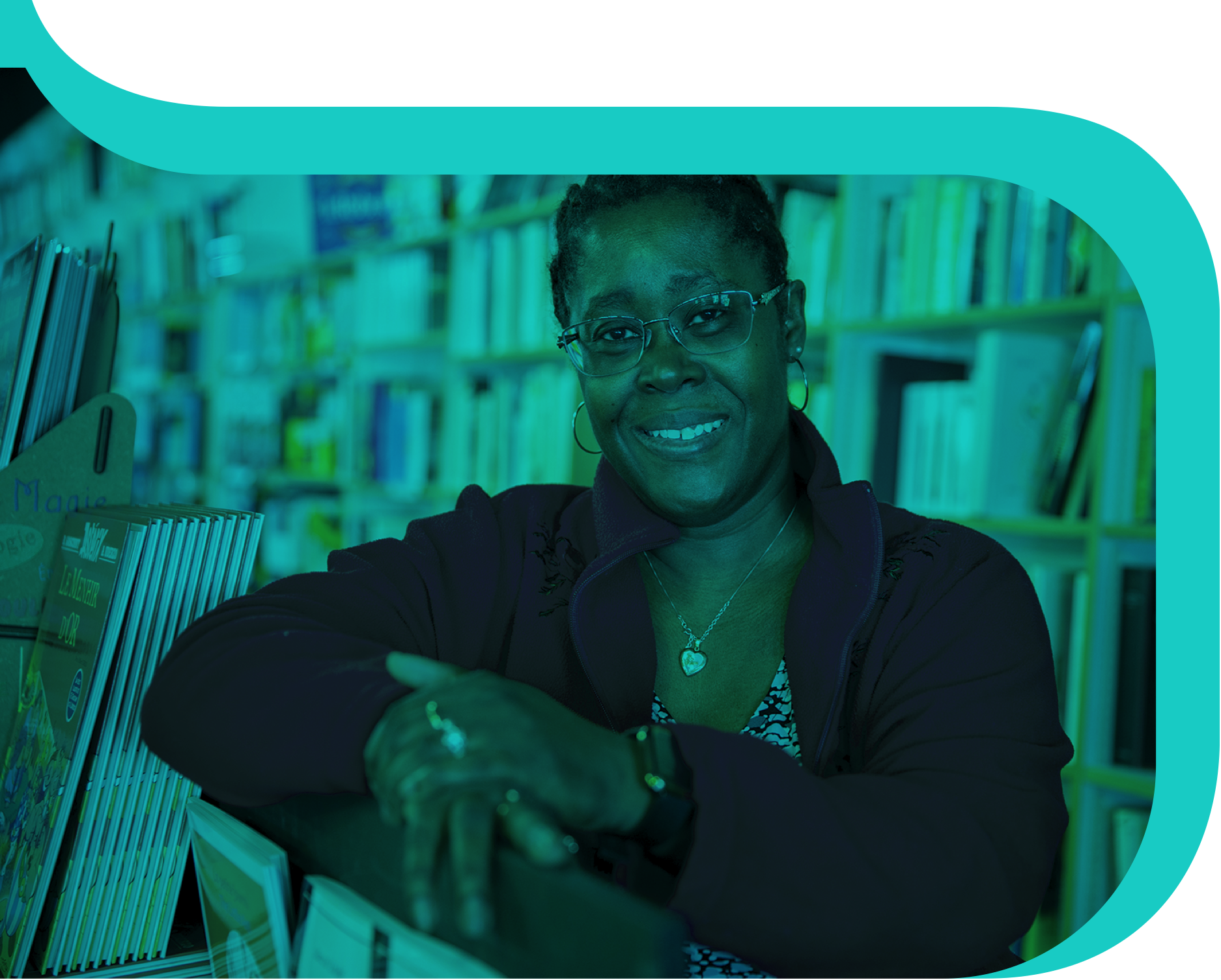
Jocelyne Doré and her husband Patrick Poudrier made the move from Quebec to southwestern Manitoba almost 20 years ago. They have never regretted that decision and enjoy all aspects of their rural Manitoba life.
When we think about newcomers, we sometimes forget that Canadians from other provinces also sometimes choose to travel hundreds or thousands of kilometres to settle in Manitoba, far from home.
This is exactly what Jocelyne Doré and her family did. “I come from Quebec, more precisely from the Saguenay/Lac-Saint-Jean region. I am of Haitian origin, but I have lived in Canada all my life.” Doré and her husband have been in southwestern Manitoba for 17 years now and are enjoying life here.
One of the reasons they came was for work. “At the time, my husband, Patrick Poudrier, had just finished his Bachelor of Education degree. He was looking for work and was offered a job in the high school at École régionale Notre-Dame.
“We seized this opportunity and we have not regretted it! One of the things my husband was adamant about was that if we moved to another province, we had to be able to live in French. And that is exactly what we found at Notre-Dame-de-Lourdes.”
On arrival, the couple immediately felt accepted and welcome in their new community. “We really received a very good welcome. On the first evening, the principal of the school at the time even invited us to dinner. He showed us around town. He showed us what we needed to know.
“My husband also received alot of help from his colleagues. I think that’s really good. He had just graduated, he wasn’t much older than the students, so getting help from his new colleagues was a big plus for him.”
Later, when the family grew, the couple was more than happy to live in a small town. “We had two boys born here, Alexandre and William, now 18 and 14. When they were born, I really enjoyed being in a town like Notre-Dame-de-Lourdes. I was far from home, from my family, but the friends I made here helped me a lot.
“Being in a town is reassuring when you arrive. We didn’t feel lost. We integrated faster than we would have in the city, I think.”
As for the distance from Winnipeg, it has never been an obstacle for Jocelyne Doré. “Yes, we are a bit far from Winnipeg, but I think we gain in quality of life.”
In order to integrate more easily, Jocelyne Doré has not hesitated to join the town activities. “At first, when my children went to the CPEF (Centre de la petite enfance et de la famille), I was able to meet other Francophone parents.
“I also got involved in the Comité culturel de Notre-Dame-de-Lourdes. I have been a member of this committee for about 13 years. I started as a simple member before taking a more important part. Today, I am the president of the committee. I am also a Lieutenant in the 127 Pembina Mountain Cadet Corps, and vice-president of the ACFM (Association culturelle franco-manitobaine).”
She also got a job, “as a library assistant at the same school as my husband.”
Getting involved in her new community has allowed Jocelyne and her family to make friends in French. “Getting involved in cultural activities in my town has allowed me to meet people, and also to give back to the community that welcomed me and my family so well. Even after 20 years, I am still discovering things. I really like our life here in the town of Notre-Dame-de-Lourdes.”
CITATION
“It was the first time they saw that there were Francophone communities outside of Winnipeg, and therefore French in all directions in the province!”