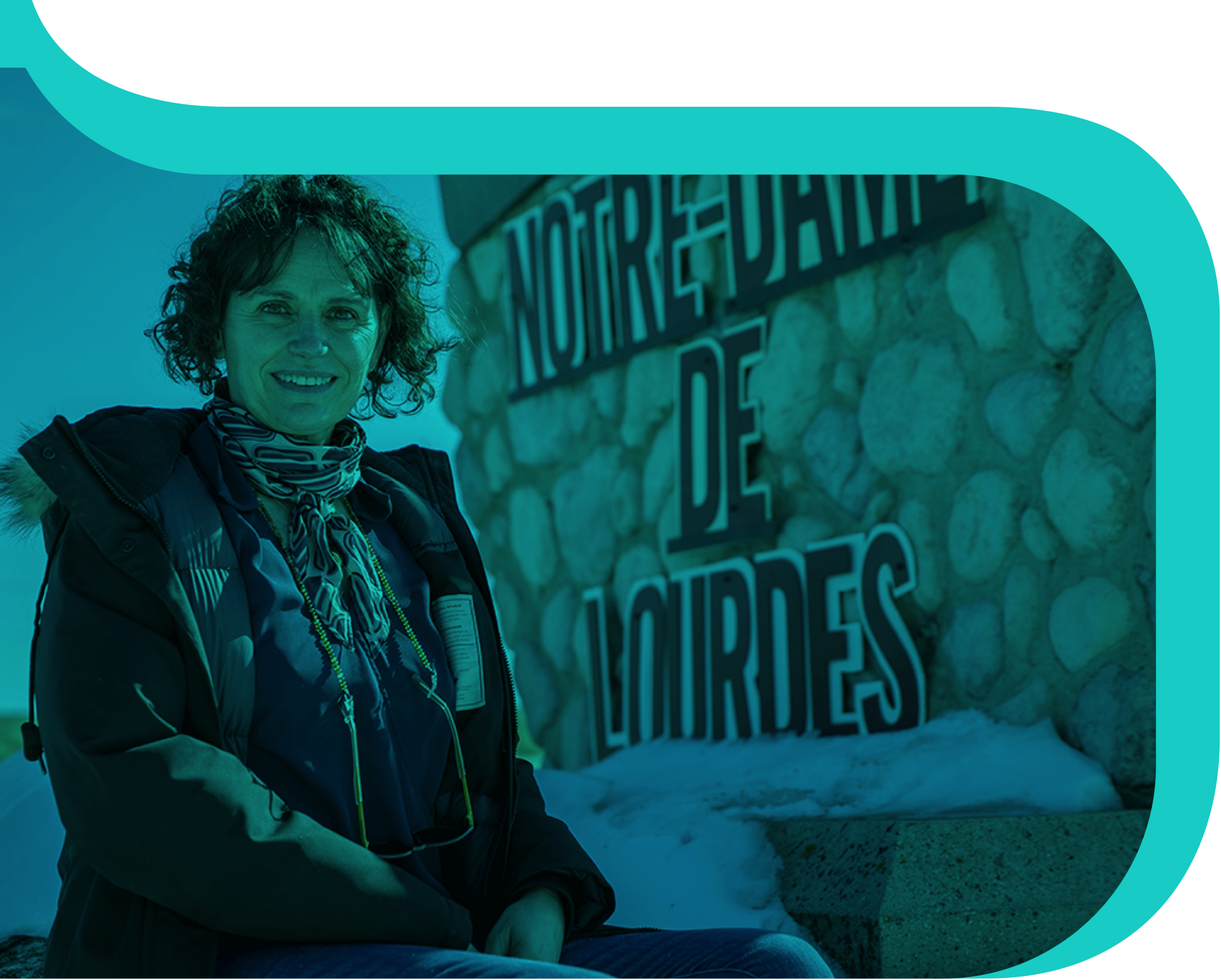
French teacher Virginie Mazoyer settled in Manitoba, in Notre-Dame-de-Lourdes, in December 2016. This was a conscious choice, as she had fallen in love with the province a few years earlier.
The first time she heard about Manitoba, Virginie Mazoyer was dubious. She recalls: “A friend of mine has been living in Winnipeg for more than ten years. When she returned to France and told me about her host province, Manitoba seemed so far away from what I knew! I wanted to take a look for myself, and I came to visit her in 2013.”
After this first trip, Virginie Mazoyer was convinced: Manitoba was made for her! Back in France, she started the administrative steps to immigrate, and started looking for a job. And she has no regrets.
“When I started applying for jobs, I immediately targeted rural communities. I wanted a different experience from what I was living in France. So I sent unsolicited applications to all the rural schools in the Division scolaire franco-manitobaine. I received a few responses, and finally I made my way to Notre-Dame-de-Lourdes.”
Upon her arrival in December 2016, the teacher felt at home. “I arrived with my two youngest children and our 16 suitcases … and right away I felt welcome.
“It is important to know that there is not much in the way of rental accommodation in Notre-Dames-de-Lourdes, but I was lucky. The principal of the school at the time offered to share the house she was renting. It was so nice of her! After that, I felt integrated very quickly.”
For Virginie Mazoyer, one of the major assets of rural life is the community spirit that reigns there. “It’s this caring that made me dream so much before coming to Manitoba. And I found it here in Notre-Dame-de-Lourdes, beyond what I expected.”
But, for the teacher, the benefits of rural life don’t stop there. “In Notre-Dame-de-Lourdes, I don’t have to use my car. I can walk to school, or even to the hospital if I need to. Everything is close by. It’s true that we have fewer cultural offerings, but if I want to go see a show, I talk about it to the people around me and there are always many people who want to go. So we carpool and off we go to spend a great evening together in the city!”
The monetary aspect is also an asset for Virginie Mazoyer. “Here, I pay a paltry sum in rent for a house with three bedrooms and land. If I wanted that in Winnipeg, I would easily pay double or triple.”
In terms of her work as a teacher, working in rural areas is also an advantage. “I like to have small classes, with few students. Since there are not many students, we have time to help our students on a case-by-case basis.
“In addition, the atmosphere at the school is much more friendly, more familial than what I knew in France. We get so much gratitude here. I feel very happy.”
For the native French woman, the choice of rural Manitoba is the right one in every way. The proof is in the pudding. “I notice that many young people who went to the city for their studies come back to Notre-Dame-de-Lourdes to raise their children,” she concludes.
Better Reflect Diversity to Strengthen the Sense of Belonging
Bernard Lesage, Chair of the Commission scolaire franco-manitobaine:
“It goes without saying that immigration, and the possibility of bringing people from outside Manitoba and even Canada to our schools, is a very important asset. ”
“Not only to meet the shortage of staff, whether teachers, assistants, custodians, etc., but also to better represent the diversity of our Franco-Manitoban community today. ”
“For our student population, it is very important to be able to see and recognize ourselves in the staff in the schools. It reinforces the sense of belonging to the school and to the community as a whole.”
“People in small towns tend to be much more direct and patient than those in big cities. There are a lot of advantages to being in a rural area. We’re like a big family.”